
Drill Bucket
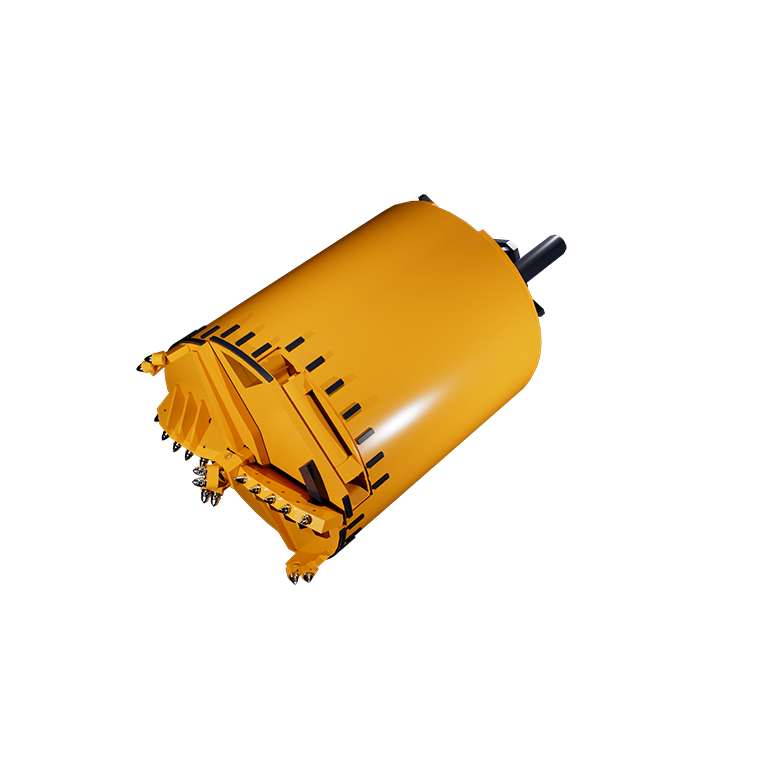
The drill bucket is used when drilling in water, drilling fluid, or very soft, cohesive soils. It also ensures a flat, cleared bottom of the borehole. The rotating hinged bottom can be opened by turning clockwise (the locking direction of the kelly bar) to feed material into the drill bucket. The filled drill bucket is closed by turning it counterclockwise (the unlocking direction of the kelly bar).
For optimal drilling in a variety of rock types, the drill bucket can be equipped on its underside with various cutting edges, pilot bits, teeth, and chisels. The simplest design—without a pilot bit but with a scraper bar—is suitable for cleaning the bottom of the borehole. Drill buckets with a single-edged rotating hinged bottom and flat teeth are used in soft to semi-cohesive cohesive soils as well as in non-cohesive soils up to dense deposits. For larger diameters (starting at approx. 1.5 m) and for uncased boreholes, the drill bucket should be equipped with two cutting edges. To prevent suction (piston effect) when pulling the drill bucket or when using a support fluid, LEFFER drill buckets are equipped with a flow channel.
On smaller models, the bucket is closed using a rotary latch; on larger diameters, it is closed using a hook-and-flap mechanism.
For soft ground, we recommend our BE and BE-2 models; for hard ground, the BEF and BEF-2 models; and for clearing the drill floor, the BER model.